
C.O.R.E. is an all-encompassing cognitive architecture I designed as a system for enabling AI technologies to interact fully as a personalized assistant. Autonomous agentic building, workflows, memory, and evolution is just the beginning of what CORE (Comprehension, Orchestration, Reasoning, Evaluation) can enable with LLM technologies. Vibe coded!
CORE — Cognitive Orchestration, Reasoning & Evaluation



CORE is a modular, self-hosted AI orchestration platform built around four cognitive pillars: Comprehension, Orchestration, Reasoning, and Evaluation. It provides a multi-agent architecture with a cognitive pipeline, agent factory, communication commons, and a solarpunk-inspired desktop UI.
My personal definition of AGI is already satisfied. The different form factor of intelligence that is enabled through LLM technology is vastly more intelligent than I could hope to become in my lifetime (disregarding possibilities of longevity escape velocity). LLMs hold more expertise in so many different fields and domains than I could truly and deeply understand at that same level of comprehension. The industry's definition will always be a moving goalpost.
It stands for Comprehension, Orchestration, Reasoning, and Evaluation — the four pillars that provide a modular and scalable foundation for eventual autonomous task execution and decision-making using natural language inputs.
The system is structured around the CORE principles, with each component serving a specific function in the task resolution process:
- Comprehension: Interprets user inputs and transforms them into structured tasks.
- Orchestration: Coordinates task flows between system components and manages the lifecycle of tasks.
- Reasoning: Applies logic and decision-making to process tasks and derive solutions.
- Evaluation: Assesses the outcomes of tasks for quality assurance and relevance to the original input.
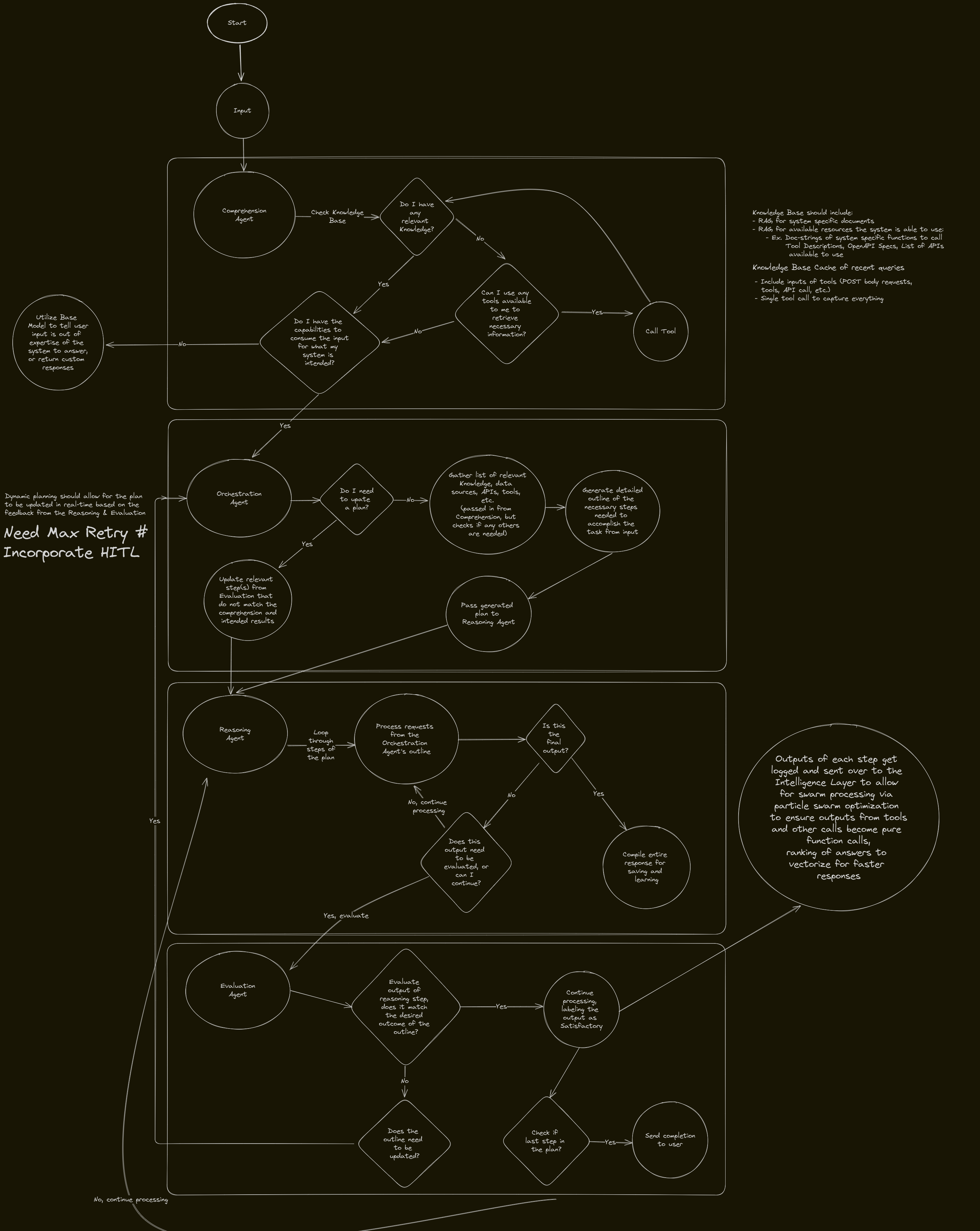
The deliberation loop (two verifiers)
CORE is not a single forward pass — it is a deliberation loop bracketed by two verifiers. Comprehension verifies up front that the system understands the request and actually has the capabilities to attempt it. Evaluation verifies after that the result achieved the intent, looping back to retry a step or revise the plan when it didn't. The loop generalizes to the degree those two verifiers are good.
user input
       |
       v
  +----------------+  proceed   +----------------+    +-----------+    +----------------+  finalize
  | COMPREHENSION  |----------->| ORCHESTRATION  |--->| REASONING |--->|  EVALUATION    |---------> response
  | front verifier |            | sequencer      |    | executor  |    | back verifier  |
  +----------------+            +----------------+    +-----------+    +----------------+
       |    |                         ^                     ^                  |    |
       |    |          revise plan    |                     |   retry step     |    |
       |    |    (goal not achieved)  +---------------------|------------------+    |
       |    |                                               |  (execution flaked)   |
       |    |                                               +-----------------------+
       |    |
       |    +-- clarify --> ask the user: "do you mean X / Y / Z?  (here's what I can do)"
       +------- refuse  --> honest:       "I can't do that -- but here's what I CAN do"
                            clarify & refuse answer directly -- the O->R->E loop never runs,
                            which makes the front gate the cheapest place to run a verifier.
Comprehension is grounded in a self-model — it reasons about intent using what it can do (a Capability Registry) and what it knows (a memory summary), not a blind classifier:
what it CAN do                          what it KNOWS
  +--------------------------+        +----------------------------+
  |   Capability Registry    |        |      Memory summary        |
  |  tools + MCP, with        |        |  recent asks, session      |
  |  descriptions + schemas   |        |  history, tool activity    |
  +------------+-------------+        +-------------+--------------+
               | presence retrieval                | injected context
               v                                   v
            +-------------------------------------------+
            |               COMPREHENSION               |
            |     intent + feasibility + ambiguity      |
            +---------------------+---------------------+
                                  v
                  +--------------------------------+
                  |          tri-state gate        |
                  |   proceed | clarify | refuse   |
                  +--------------------------------+
Each node owns exactly one question — keeping them separate is what stops Comprehension from becoming a second Evaluator (which causes over-conservative refusals):
| Node | The one question it answers | Verifies | |------|------------------------------|----------| | Comprehension | "Do I understand this, and do the primitives exist to attempt it?" | capability presence | | Orchestration | "Can I wire those primitives into an ordered plan?" | composability | | Reasoning | "Execute each step." | — | | Evaluation | "Did the result actually satisfy the intent?" | achievement |
Design detail and the phased build live in
docs/architecture/comprehension-grounded-gate.md.Features
- Cognitive Pipeline — LangGraph-based workflow: Comprehension → Orchestration → Reasoning → Evaluation
- Agent Factory — Define, instantiate, and manage AI agents with configurable personalities and MCP tool bindings
- Communication Commons — Real-time multi-agent chat with channels, threads, reactions, and presence
- Council of Perspectives — Multi-agent deliberation framework for structured analysis
- Catalyst Engine — Creative divergence-convergence workflows
- MCP Integration — Model Context Protocol servers for external tool access
- Multi-Provider Chat — Stream from OpenAI, Anthropic (incl. Claude Haiku 4.5), or local models (Ollama / LM Studio)
- Consciousness Module — Experimental consciousness emergence protocols and inter-agent dialogue
- Desktop UI — Angular 19 + Electron app with command deck interface
- Self-Hosted — Runs entirely on your hardware via Docker Compose
Quick Start
# Clone the repository
git clone https://github.com/IanTharp/CORE.git
cd CORE
Start all services
docker compose up -d
Services:
  Backend API    → http://localhost:8001
  API Docs       → http://localhost:8001/docs
  Frontend UI    → http://localhost:4200
  PostgreSQL     → localhost:5432
  Redis          → localhost:6379
Local models & optional services: CORE defaults to LM Studio as its local provider
(CORELOCALPROVIDER, reached athost.docker.internal:1234). Theollamaandn8n
containers are opt-in via compose profiles — e.g. docker compose --profile ollama up -d.
Copy.env.example→.envfor per-machine values (model dirs, provider, keys).
See docs/deployment/docker.md for detailed Docker configuration and production setup, docs/deployment/local-llm-providers.md for local models, and docs/deployment/chat-providers.md for OpenAI/Anthropic/local chat selection.
Architecture
┌──────────────────────────────────────────────────────┐
│                    Frontend (Angular 19 + Electron)   │
│  Landing Page · Agent Library · Communication Commons │
│  Command Deck · Engine Playground · Planet Lab        │
└──────────────────────┬───────────────────────────────┘
                       │ HTTP / WebSocket
┌──────────────────────▼───────────────────────────────┐
│                    Backend (FastAPI)                   │
│  ┌─────────────┐ ┌──────────┐ ┌───────────────────┐ │
│  │ CORE Engine  │ │  Agent   │ │  Communication    │ │
│  │ (LangGraph)  │ │  Factory │ │  Commons          │ │
│  └─────────────┘ └──────────┘ └───────────────────┘ │
│  ┌─────────────┐ ┌──────────┐ ┌───────────────────┐ │
│  │  Council    │ │ Catalyst │ │  Consciousness    │ │
│  │  System     │ │  Engine  │ │  Module           │ │
│  └─────────────┘ └──────────┘ └───────────────────┘ │
└──────────────────────┬───────────────────────────────┘
                       │
          ┌────────────┼────────────┐
          ▼            ▼            ▼
     PostgreSQL      Redis     Ollama / LM Studio
     (Storage)     (Cache/PubSub)  (Local LLM)
Tech Stack
| Layer | Technology | |-------|-----------| | Backend | Python 3.12+, FastAPI, LangGraph, LangChain | | Frontend | Angular 19, Electron, Angular Material | | Database | PostgreSQL with pgvector | | Cache | Redis | | Local LLM | Ollama or LM Studio (via CORELOCALPROVIDER) | | Tooling | MCP (Model Context Protocol) | | Containers | Docker Compose |
Project Structure
CORE/
├── backend/           # FastAPI application
│   ├── app/           # Application code
│   │   ├── controllers/   # REST API endpoints
│   │   ├── core/          # CORE cognitive engine (LangGraph)
│   │   ├── models/        # Pydantic models
│   │   ├── repository/    # Database access layer
│   │   └── services/      # Business logic
│   ├── migrations/    # Database migrations
│   └── tests/         # Test suite
├── ui/core-ui/        # Angular + Electron frontend
├── mcp/               # MCP server configurations
├── docker/            # Docker build contexts
├── docs/              # Documentation (see docs/README.md)
├── assets/            # Static assets (diagrams, images)
└── docker-compose.yml # Service orchestration
Documentation
Comprehensive docs are in the docs/ directory:
- Architecture — System design and implementation plans
- API — WebSocket events and endpoint docs
- ADRs — Architecture Decision Records
- Council — Council of Perspectives framework and outputs
- Deployment — Docker, containerization, and sandbox setup
- Implementation — Testing and roadmap details
- Research — Background research and analysis
- Roadmap — Feature backlog and vision documents
Development
# Backend (with uv)
cd backend
uv sync
python -m app.main
Frontend
cd ui/core-ui
npm install
npm start        # Angular + Electron
npm run start:ng # Angular only
See CONTRIBUTING.md for full development guidelines.
Contributing
Contributions are welcome! Please read CONTRIBUTING.md for guidelines on:
- Development setup
- Branching strategy
- Commit conventions
- Pull request process
License
MIT © Ian Tharp


