
(ICML 2026) IDLM: Inverse-distilled Diffusion Language Models
IDLM: Inverse-distilled Diffusion Language Models
By
David Li*, Nikita Gushchin*, Dmitry Abulkhanov, Eric Moulines, Ivan Oseledets, Maxim Panov, Alexander Korotin






What is IDLM?
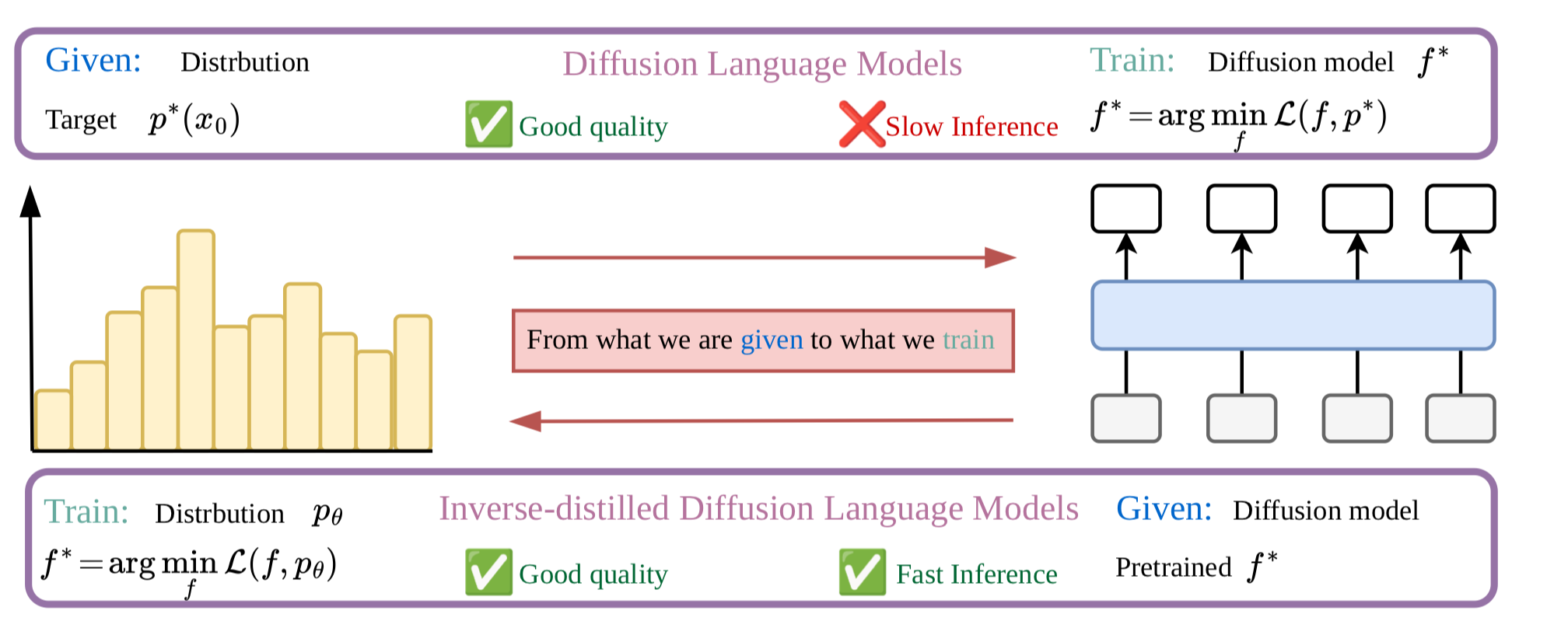
Diffusion Language Models can generate high-quality text, but their iterative reverse-diffusion sampling makes inference slow. IDLM speeds them up by distilling a pretrained many-step diffusion language model into a few-step generator.
Instead of simply matching every teacher step, IDLM uses an Inverse Distillation view for discrete token spaces.The paper reports 4×–64× fewer inference steps while preserving the teacher model’s generation quality.
Repository layout
IDLM/
├── configs/                 # Hydra configs: data, model, algo, strategy, callbacks, etc.
│   ├── algo/                # ar, mdlm, duo, duo_base, d3pm, sedd
│   ├── data/                # OpenWebText and TinyGSM/GSM8K configs
│   │   ├── tiny-gsm.yaml    # TinyGSM training/evaluation data config
│   │   └── gsm8k-test.yaml  # GSM8K/TinyGSM benchmark evaluation config
│   ├── model/               # tiny / small / medium model configs
│   ├── noise/               # diffusion noise schedules
│   └── config.yaml          # main experiment config
├── integral/                # precomputed tokenizer / integration assets, including SmolLM TinyGSM support
├── models/                  # DiT backbone, EMA utilities, attention tests
├── scripts/                 # training and generation recipes
├── algo.py                  # model families and IDLM distillation logic
├── dataloader.py            # tokenizers, OpenWebText/TinyGSM datasets, dataloaders
├── main.py                  # Hydra + Lightning entry point
├── metrics.py               # perplexity, entropy, BPD, NLL metrics
├── trainer_base.py          # shared training / sampling base classes
├── utils.py                 # logging and helper utilities
├── requirements.txt         # environment note / dependency list
└── LICENSE
Getting Started
1. Clone the repository
git clone https://github.com/David-cripto/IDLM.git
cd IDLM
2. Create an environment
To get started, create a conda environment containing the required dependencies.
conda create -n idlm python=3.12
conda activate idlm
conda install nvidia/label/cuda-12.4.0::cuda-toolkit
pip install -r requirements.txt
pip install flash_attn==2.7.4.post1
Checkpoints
- IDLM-MDLM. Trained on OpenWebText:
- IDLM-MDLM. Trained on TinyGSM:
- IDLM-Duo. Trained on OpenWebText:
- IDLM-Duo. Trained on TinyGSM:
- IDLM-DCD. Trained on OpenWebText:
Train IDLM
This section provides reference training entry points for unconditional OpenWebText distillation and conditional TinyGSM distillation. The scripts are written as Hydra override recipes, update the dataset cache and checkpoint paths before launching a run.
Unconditional OpenWebText Distillation
The OpenWebText recipes train IDLM students for unconditional language generation. Before executing the scripts, configure the cache_dir parameter in configs/data/openwebtext-split.yaml to specify the desired output path.
MDLM teacher → IDLM-MDLM student
bash scripts/trainidlmmdlm.shDUO teacher → IDLM-Duo student
bash scripts/trainidlmduo.shDCD teacher → IDLM-DCD student
bash scripts/trainidlmdcd.shConditional TinyGSM Distillation
The TinyGSM recipes train IDLM students for conditional mathematical reasoning on TinyGSM-style question-answer examples. Before executing the scripts, configure cachedir in configs/data/tiny-gsm.yaml and replace the training.finetunepath placeholder in each script with the corresponding pretrained teacher checkpoint. Our TinyGSM distillation runs use the teacher checkpoints from the S-FLM repository: MDLM for IDLM-MDLM and Duo for IDLM-Duo.
MDLM teacher → IDLM-MDLM TinyGSM student
bash scripts/trainidlmmdlm_tynigsm.shDUO teacher → IDLM-Duo TinyGSM student
bash scripts/trainidlmduo_tynigsm.shEvaluation
This section separates unconditional OpenWebText generation from conditional TinyGSM benchmark evaluation.
Unconditional OpenWebText Evaluation
The generation scripts sweep over 4, 8, 16, and 32 sampling steps.
Before running them, set eval.generatedsamplespath to a real JSON output path.
IDLM-MDLM checkpoint
mkdir -p samples
python -m main \   mode=sample_eval \   loader.batch_size=2 \   loader.evalbatchsize=8 \   data=openwebtext-split \   algo=mdlm \   algo.backbone=hf_dit \   eval.checkpoint_path=kekchpek/idlm-mdlm \   sampling.steps=16 \   sampling.numsamplebatches=10 \   sampling.predictor=ancestral_cache \   sampling.noise_removal=ancestral \   +wandb.offline=true \   eval.generatedsamplespath=samples/idlmmdlm16steps.json
IDLM-Duo checkpoint
mkdir -p samples
python -m main \   mode=sample_eval \   loader.batch_size=2 \   loader.evalbatchsize=8 \   data=openwebtext-split \   algo=duo \   algo.backbone=hf_dit \   eval.checkpoint_path=kekchpek/idlm-duo \   sampling.steps=16 \   sampling.numsamplebatches=10 \   sampling.noise_removal=greedy \   +wandb.offline=true \   eval.generatedsamplespath=samples/idlmduo16steps.json
IDLM-DCD checkpoint
mkdir -p samples
python -m main \   mode=sample_eval \   loader.batch_size=2 \   loader.evalbatchsize=8 \   data=openwebtext-split \   algo=duo \   algo.backbone=hf_dit \   eval.checkpoint_path=kekchpek/idlm-dcd \   sampling.steps=4 \   sampling.numsamplebatches=10 \   sampling.noise_removal=greedy \   +wandb.offline=true \   eval.generatedsamplespath=samples/idlmduo4steps.json
Run the provided scripts
bash scripts/generationidlmmdlm.sh
bash scripts/generationidlmduo.sh
bash scripts/generationidlmdcd.sh
Generated sample files contain:
{
  "generative_ppl": 0.0,
  "entropy": 0.0,
  "generated_seqs": []
}
Conditional TinyGSM Evaluation
We release the TinyGSM IDLM checkpoints on Hugging Face: IDLM-MDLM TinyGSM and IDLM-Duo TinyGSM. To evaluate these conditional models on the TinyGSM benchmark, use the .ckpt files from the Hugging Face repositories together with the TinyGSM evaluation code from the S-FLM repository.
Outputs
By default, Hydra writes experiment outputs under:
outputs/<dataset>/<date>/<time>/TensorBoard logs are written under:
tb_logs/Checkpoints are written according to the checkpointing config in configs/config.yaml.
Citation
If you find this repository useful, please cite:
@article{li2026idlm,
  title={IDLM: Inverse-distilled Diffusion Language Models},
  author={Li, David and Gushchin, Nikita and Abulkhanov, Dmitry and Moulines, Eric and Oseledets, Ivan and Panov, Maxim and Korotin, Alexander},
  journal={arXiv preprint arXiv:2602.19066},
  year={2026}
}
Acknowledgements
Our codebase is inspired by recent Discrete Diffusion Models projects. Namely, MDLM, Duo, and S-FLM.
License
This project is released under the MIT License. See LICENSE for details.


