
No description available.
Chorus
Cohort-consensus tracker for smart-money behavior on Solana.
See when smart money is actually aligned instead of just noisy in one pocket.
bun run dev
- watches makers, funds, teams, and traders as separate cohorts
- ignores one-cohort inventory skew that looks bigger than it is
- promotes tokens where multiple cohorts agree on direction at the same time


Consensus Board • Signal Feed • Operating Surfaces • Cohort Separation • Consensus States • Technical Spec • Quick Start
At a Glance
Use case: detect when multiple Solana wallet cohorts actually agree on a namePrimary input: cohort weighting, wallet tiering, timing alignment, agreement ratioPrimary failure mode: mistaking one-cohort inventory skew for broad convictionBest for: operators who need to know whether smart-money alignment is real or isolated
Live Agreement Wall
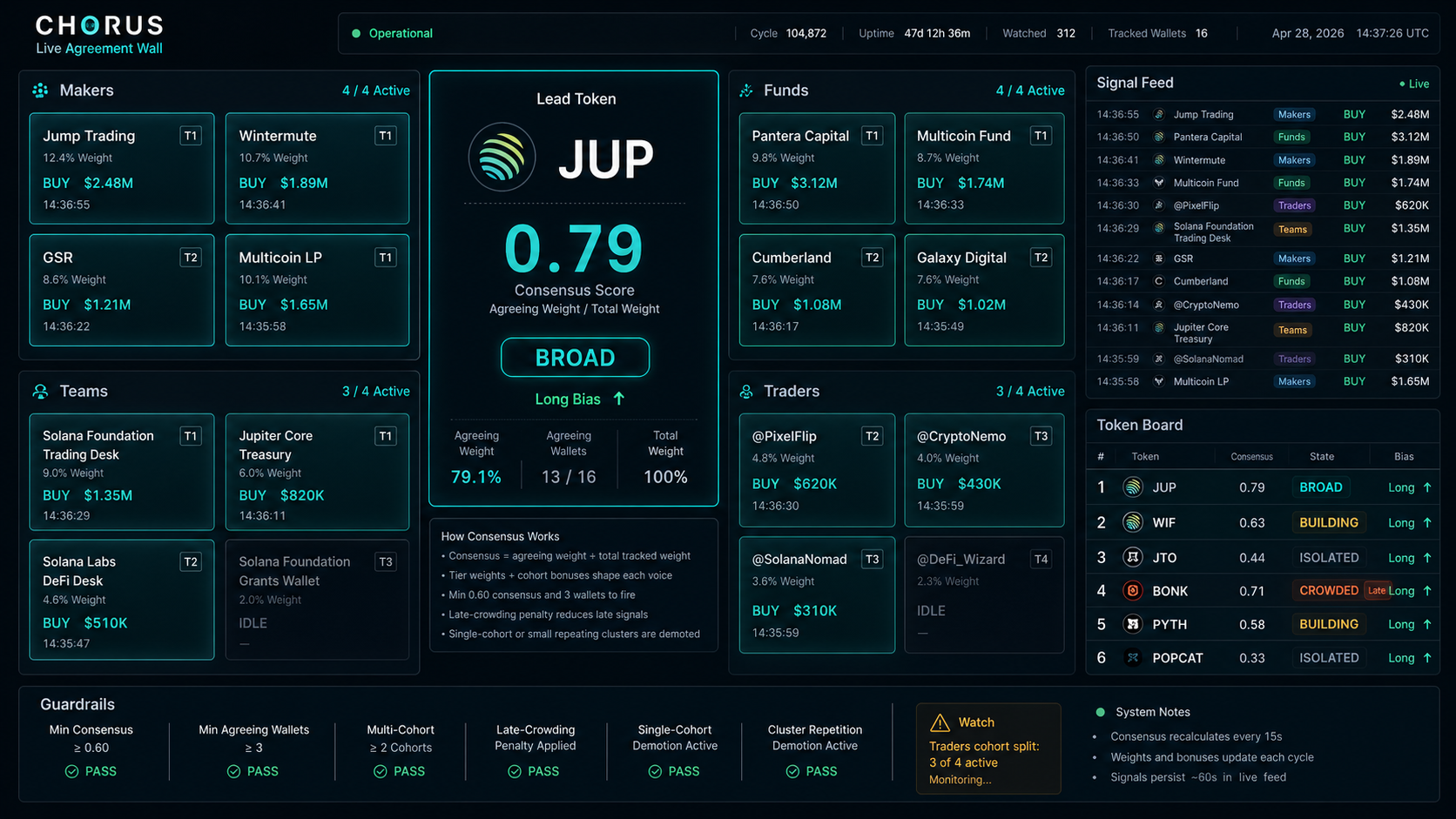
Live operating view for Chorus: lead token consensus card, four cohort sectors with active and idle smart-money wallets (makers, funds, teams, traders), signal feed, token board, guardrails, and the agent's current ISOLATED, BUILDING, BROAD, or CROWDED state.
Operating Surfaces
Consensus Board: shows whether conviction is broad or isolated to one cohortSignal Feed: prints the actual names climbing the alignment stackCohort Weighting: ranks makers, funds, teams, and traders separately before blendingAgreement Score: converts wallet activity into a usable conviction state
Why Wallet Tracking Usually Breaks Down
Most wallet dashboards collapse all "smart money" into one stream. That looks useful until a single cohort dominates the tape and the board starts pretending there is broad agreement when there is not.
Chorus avoids that mistake on purpose. It keeps funds, makers, teams, and traders separated long enough for the operator to see whether conviction is actually spreading or only echoing within one group.
Why Cohorts Stay Separate
Chorus does not believe that "smart money" is one thing. Funds, makers, teams, and fast traders all behave differently, and collapsing them into one blended wallet list hides that difference.
A maker leaning on inventory is not the same as broad cross-cohort agreement. Chorus exists to keep those cases separate until the market actually lines up.
Consensus States
The board is easier to use when the operator can name the state:
isolated: one cohort is moving, everyone else is absentbuilding: two cohorts are starting to agreebroad: multiple cohorts are aligned on the same name and directioncrowded: agreement exists, but the move is too late to treat cleanly
How It Works
Chorus turns wallet activity into an interpretable conviction state:
- split the tracked wallets into separate cohorts
- weight the wallets by tier instead of treating every address equally
- measure whether the same token and direction are appearing across cohorts
- convert that alignment into a consensus state the operator can understand
- print the names where agreement is broad enough to matter
What The Operator Learns From Chorus
The board is trying to answer three practical questions:
- who moved first
- who confirmed the move after that
- whether the agreement is becoming broader or only louder
Example Output
CHORUS // CONSENSUS SNAPSHOT
lead token        JUP agreement score   0.79 active cohorts    makers, funds, traders state             broad late crowding     low
operator note: alignment is real across more than one cohort, not just one pocket
Technical Spec
Chorus computes agreement in two layers:
Tier Weight
tier1 = 3
tier2 = 2
tier3 = 1
Cohort Bonus
market_maker = 1.2
fund = 1.1
team = 1.0
trader = 0.9
Consensus Score
consensusScore = agreeingWeight / totalTrackedWeight
Signals strengthen when multiple cohorts align. A single cohort can still be useful, but broad cross-cohort agreement is treated as the higher-conviction state.
When Chorus Should Demote A Signal
- only one cohort is active and everyone else is absent
- agreement exists, but comes too late after the move is obvious
- the same small cluster keeps appearing without broader confirmation
- team or maker activity looks more like inventory management than conviction
Risk Controls
cohort separation: prevents one group from impersonating broad agreementtier weighting: stops low-quality wallet clusters from dominating the scorelate crowding check: downgrades names where agreement arrives too lateconsensus threshold: requires enough aligned weight before promoting a signal
Why Chorus Works On Busy Days
Wallet tracking becomes unreadable when every feed just dumps buys and sells into one stream. Chorus keeps the interpretation layer intact.
That means the operator can tell the difference between real agreement and one noisy wallet pocket dragging attention around.
Quick Start
git clone https://github.com/ChorusSignals/Chorus
cd Chorus
npm install
cp .env.example .env
npm run dev
Local Audit Docs
Support Docs
License
MIT


