
Synthetic benchmark for privacy-preserving and fairness-aware ranking under signal loss
FairPrivacySignal


In plain language
Computer systems in many fields rank options to offer people — which health program to suggest, which course or support service, which local resource. To do this well, they often rely on a person's past activity. New U.S. privacy rules increasingly restrict that data. That protects people, but it also makes these systems less accurate, and it tends to hurt the people and small organizations with the least data to begin with.
FairPrivacySignal is a free, public, open-source tool showing how such a system can stay useful without using restricted personal data — by rebuilding a privacy-safe stand-in from information it is still allowed to use. It ships the method, a test harness, and honest measurements.
What it shows, in plain terms: when the behavioral data is fully removed, the method recovers roughly a third of the lost ranking quality; when some data remains, it recovers more than half. These are results on controlled, synthetic test data, reported with their limits — not a claim of real-world deployment.
Why it matters beyond any one company: the same problem recurs across U.S. healthcare, education, public services, financial access, and online marketplaces. Released openly rather than kept inside a single company, the method can be inspected, reproduced, and reused by anyone working on it.
Bottom line: a privacy-era capability that many U.S. sectors need, built in the open so the whole field — not a single employer — can inspect and use it.
Open, public, and independently verifiable
FairPrivacySignal is an independent, open-source project, public and non-proprietary by design: the full method, code, synthetic-data generator, and results are MIT-licensed and permanently archived with a citable DOI (10.5281/zenodo.20130952). The repository is maintained by Chang Xu; the GitHub account AnthonyXu109 belongs to the same author.
No result has to be taken on trust. With no special access or data, anyone can reproduce everything from a clean checkout:
git clone https://github.com/AnthonyXu109/FairPrivacySignal
cd FairPrivacySignal && bash scripts/verify_benchmark.sh
Using synthetic data is deliberate: it lets the entire method and its evaluation be examined in public, with no personal, proprietary, or confidential data involved. What the study does and does not claim is stated plainly in docs/limitations.md; the U.S. public-interest context, with sources, is in docs/policy_context.md.
Behavioral signals often help ranking systems distinguish among otherwise similar candidates. Those signals can become incomplete or unavailable when consent, privacy, retention, or data-minimization rules change. Removing them protects important boundaries, but it can also reduce ranking quality and affect the people whose histories are least observable.
FairPrivacySignal is an open synthetic testbed and reference implementation for recovering useful ranking information without returning unavailable event-level behavior to the serving model. Its primary method, **Policy-Aware Signal Recovery**, combines training-only cohort statistics with cross-fitted signal reconstruction, then selects or fuses those substitutes according to the availability policy.
The included experiments follow a public-service outreach example: households are ranked for services under limited behavioral history. The same design can be studied wherever a system ranks interventions, programs, providers, resources, or opportunities using a mixture of contextual and restricted historical signals.
Why this problem matters
Privacy-driven signal loss is not a single-company concern. It is an economy-wide shift in how data-driven systems in the United States are allowed to operate:
- Regulation is broad and growing. Roughly twenty U.S. states have comprehensive
- The economic stakes are large. After Apple's App Tracking Transparency moved
- Federal risk guidance expects it. The NIST AI Risk Management Framework,
- It bears on U.S. AI competitiveness. Keeping model quality and evaluation
FairPrivacySignal studies the core technical question these forces create: how can a ranking or matching system stay useful, reliable, and stable when privacy rules remove the individual-level signals it once relied on, without re-introducing restricted raw data? The method and evaluation are released publicly, on synthetic data under an open license, so the approach can be examined and reused across sectors rather than remaining internal to any one company.
At a glance
| Component | What the repository provides | |---|---| | Recovery method | Policy-conditioned substitution using privacy-safe aggregates and cross-fitted reconstruction | | Evaluation task | Synthetic household-to-service ranking with complete and partial signal-loss regimes | | Primary outcomes | Overall and low-signal NDCG@3, full-signal gap closed, and a comparative exposure proxy | | Operational extension | Capacity-constrained allocation with explicit relevance and representation tradeoffs | | Stress tests | Feature ablations, negative controls, missingness mechanisms, unseen communities, model classes, ranking objectives, and aggregate noise | | Reproducibility | Five fixed synthetic-data seeds, generated reports and figures, regression tests, and one-command verification |
All event-level records are synthetic. No personal, proprietary, or confidential data is used.
Results

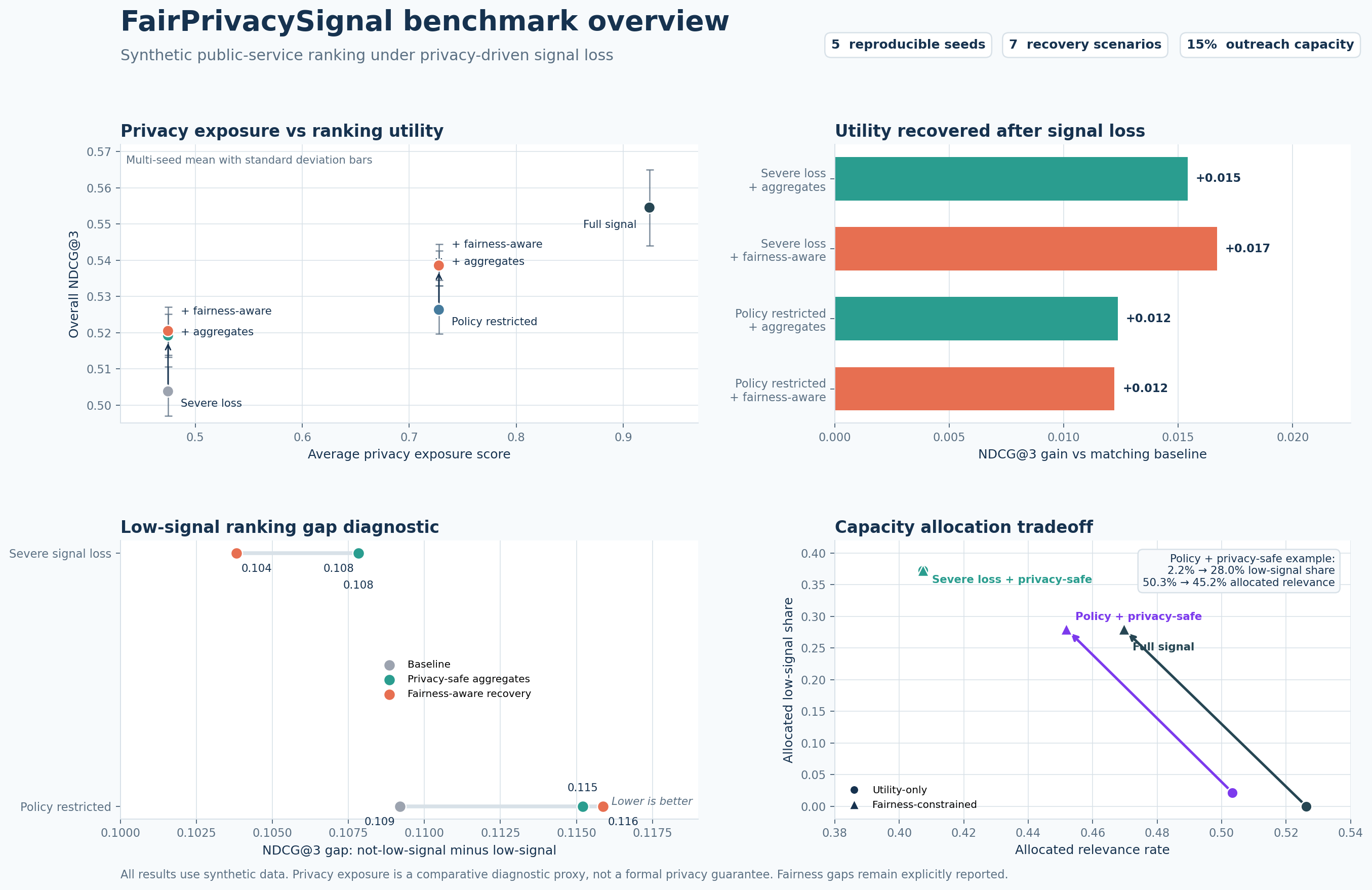
Across five paired synthetic-data seeds, Policy-Aware Signal Recovery improves ranking quality in both evaluated availability regimes:
| Signal-loss regime | No recovery NDCG@3 | Policy-aware recovery NDCG@3 | Full-signal gap closed | Low-signal NDCG@3 change | |---|---:|---:|---:|---:| | Complete behavioral-signal loss | 0.504 | 0.519 | 31.4% | +0.015 | | Policy-restricted partial signal | 0.526 | 0.542 | 56.1% | +0.016 |
The gains are positive in every paired seed. Under complete signal loss, the method closes about one-third of the synthetic utility gap to the full-signal oracle. When some observed values remain available, policy-conditioned fusion closes more than half of that gap. The benchmark's comparative exposure score remains at the matching signal-loss baseline; it tracks raw-feature availability and is not a formal privacy guarantee.
These results do not imply that recovery can recreate the full-signal system. Instead, they quantify how much useful ordering can be restored under explicit information constraints. Full tables, standard deviations, and method-specific comparisons are available in docs/policyawaresignal_recovery.md.
How the method works
Policy-Aware Signal Recovery separates offline estimation from online ranking. The implementation has two recovery paths because complete and partial signal loss present different estimation problems.
- Construct a training reference. Historical engagement from training
- Learn a contextual reconstruction. A nonlinear model estimates the
- Cross-fit the training proxies. Household-grouped folds ensure that each
- Apply the availability policy. Observed values are retained when allowed.
- Train and serve the ranker. The downstream ranking model uses the permitted
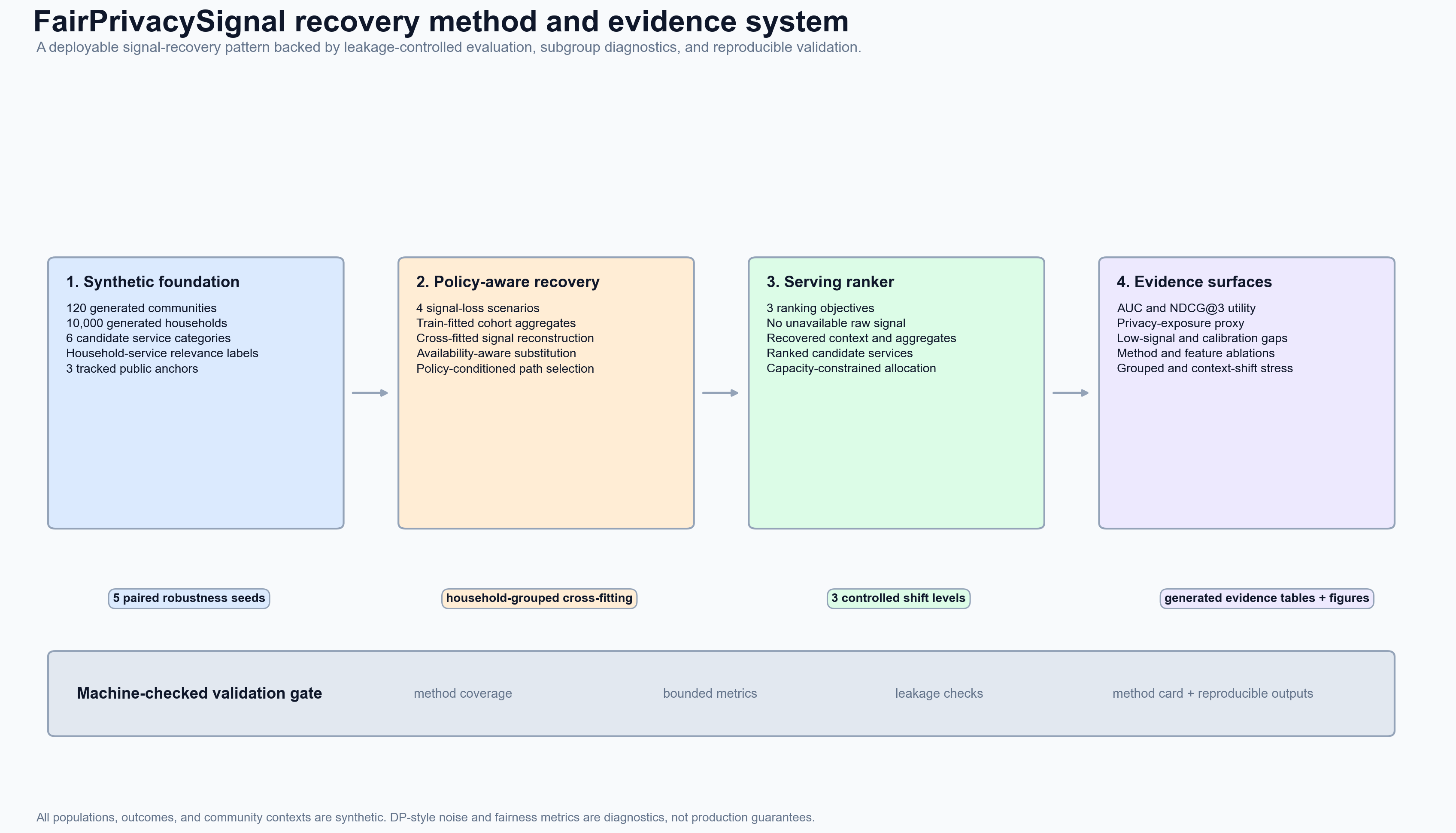
The reconstruction path assumes that historical signal may be used within a controlled offline training process even when it cannot be exposed during serving. Where offline use is also prohibited, the aggregate-only path is the relevant configuration.
What drives recovery
The feature ablation separates engagement aggregates from broader cohort-context statistics. In the current synthetic configuration, the engagement aggregate provides most of the measured improvement. Cohort context contributes a smaller increment and is not consistently useful on its own.

This matters for implementation: adding more aggregate features is not automatically beneficial. The benchmark requires each substitute group to justify its contribution against the same-seed, no-aggregate baseline. Detailed values are reported in docs/recoveryfeature_ablation.md.
Does the aggregate structure matter?
A useful substitute should help because it preserves relevant structure, not merely because another numeric feature was added. The negative control keeps the train-only aggregate construction intact while permuting service categories, breaking the relationship between the aggregate and the service being ranked.

Under severe signal loss, mean overall recovery falls from +0.0115 with aligned aggregates to -0.0014 after permutation. Under partial restriction it falls from +0.0102 to +0.0009. The low-signal result is less separated in the partial regime, so the control is interpreted metric by metric rather than as a universal effect.
See docs/aggregatealignmentnegative_control.md for the protocol and complete table.
Signal loss is not one condition
Two datasets can retain the same fraction of behavioral events while losing information from very different records. FairPrivacySignal therefore evaluates three matched-rate mechanisms: uniform-random loss, loss conditioned on observed context, and loss conditioned on the signal that is later suppressed.

Every mechanism retains 56% of events overall. Low-signal availability nevertheless ranges from 56.3% under uniform-random loss to 32.8% under signal-dependent loss. The result shows why an aggregate availability rate is not enough to characterize the difficulty or distributional effect of a privacy rule. The mechanism labels are controlled synthetic analogues, not empirical missingness diagnoses.
Full results are in docs/missingnessmechanism_sensitivity.md.
Robustness under unseen contexts
The primary protocol holds out households. A stricter stress test holds out entire synthetic communities so that training and evaluation contexts are disjoint. Recovery remains positive in both signal-loss regimes, with broad service fallback used for less than 1% of evaluated events on average.

This test checks the behavior of the recovery pipeline when local context changes; it is not a claim of geographic or temporal validation. Additional shift analyses cover held-out context combinations, model classes, and pairwise ranking:
docs/communityholdout_robustness.mddocs/heldoutcontext_shift.mddocs/model_sensitivity.mddocs/pairwiseranking_sensitivity.md
From rankings to limited capacity
Many ranking systems feed a constrained decision: a clinic has a finite number of appointments, a public program has limited outreach staff, a school has a limited number of advising slots, or a financial-access program can review only a subset of eligible applications. In these settings, improved scores do not determine the allocation policy by themselves.
FairPrivacySignal converts ranked candidates into per-service allocations and sweeps two operational choices:
- capacity rates from 5% to 30%
- low-signal allocation-floor strengths from 0% to 100%

The left panel traces allocated relevance against the share of selected low-signal candidates. The heatmaps show how stronger allocation floors reduce selection-rate gaps while changing the relevance of allocated slots. No point is labeled as universally optimal; the purpose of the sweep is to make the policy tradeoff visible before a threshold is chosen.
The complete allocation design and single-seed diagnostic figures are documented in docs/capacity_allocation.md.
Benchmark coverage
The main benchmark combines recovery quality, subgroup diagnostics, privacy exposure, and constrained allocation rather than reducing evaluation to a single accuracy number.
| Evaluation question | Included diagnostic | |---|---| | Does the method improve ranking after signal loss? | Paired five-seed overall and low-signal NDCG@3 | | Which substitutes provide the gain? | Recovery feature ablation | | Does semantic alignment matter? | Service-permuted aggregate negative control | | Does the incidence of missingness matter? | Matched-rate mechanism sensitivity | | Does recovery survive stricter separation? | Community holdout and held-out context shift | | Is the result tied to one estimator? | Model-class and ranking-objective sensitivity | | How fragile are the aggregates? | Noise-scale and cohort-threshold sweeps | | What happens after ranking? | Capacity and allocation-floor frontiers | | Are subgroup effects visible? | Low-signal ranking gaps, uncertainty audit, and allocation representation |
Supporting reports include:
- aggregate noise sensitivity
- cohort threshold sensitivity
- disparate uncertainty audit
- education student performance public-data validation
- finance German Credit public-data validation
- healthcare WDBC public-data validation
- low-signal fairness metrics
- MovieLens marketplace public-data validation
- public services Adult Census public-data validation
- public reference calibration
- sector adaptation roadmap
- underserved recovery profile
Where this pattern appears
The repository uses neutral entities and synthetic data so that the method can be examined independently of a specific application dataset.
| Setting | Ranked candidate | Historical signal that may be restricted | Examples of permitted context | |---|---|---|---| | Healthcare outreach | Appointment, screening, or care-navigation option | Prior response or service-use history | Eligibility, distance, scheduling, and program attributes | | Education | Course, advising resource, or support program | Prior participation or interaction history | Curriculum, location, availability, and consented student context | | Public and nonprofit services | Benefit, outreach program, or local resource | Historical engagement with services | Program rules, geography, capacity, and community context | | Financial access | Eligible product, assistance program, or review pathway | Prior digital interaction or response history | Product terms, eligibility, risk controls, and consented application data | | Marketplaces | Provider, listing, or local opportunity | Click, contact, or transaction history | Item, provider, location, price, and availability attributes |
These examples describe a common system shape, not validated deployments. Applying the method to any domain requires a domain-specific policy review, outcome definition, subgroup analysis, and evaluation against locally appropriate baselines. The sector adaptation roadmap lays out public-data pilots that could test the same signal-loss and recovery pattern in healthcare, education, public services, financial access, and marketplaces without using confidential data.
Five external public-data pilots are now included: MovieLens marketplace validation tests held-out movie ranking after user-history signal loss, and education student performance validation tests student-support ranking after prior-grade signal loss, and finance German Credit validation tests credit-application review ranking after financial-history signal loss, and healthcare WDBC validation tests diagnostic-case triage after detailed clinical-measurement signal loss, and public services Adult Census validation tests low-income support outreach after detailed economic signal loss. Together they show the same signal-loss and privacy-preserving recovery pattern outside the repository's synthetic benchmark.
Public-Data Evidence Gallery
Each panel uses the same single-view ladder: how much of the full-signal gap is closed, and how much restricted signal exposure each method uses.
Healthcare |
Education |
Public Services |
Financial Access |
Marketplaces |
Reproduce the benchmark
FairPrivacySignal is designed to run on an ordinary laptop with NumPy, pandas, scikit-learn, and Matplotlib.
python -m venv .venv
source .venv/bin/activate
python -m pip install --upgrade pip setuptools wheel
python -m pip install -r requirements.txt
bash scripts/verify_benchmark.sh
The verification command runs regression tests, compilation checks, the complete benchmark pipeline, figure generation, and required methodological validations. Generated tables, reports, and figures are deterministic for the fixed seeds.
Useful entry points:
| Path | Purpose | |---|---| | fairprivacysignal/ | Data generation, policies, recovery methods, ranking, evaluation, and plotting | | scripts/verify_benchmark.sh | End-to-end verification | | docs/benchmark_design.md | Task definition, controls, and evaluation protocol | | docs/experiment_matrix.md | Scenario and sensitivity coverage | | docs/educationstudentperformance_validation.md | Public education support validation | | docs/financegermancredit_validation.md | Public financial-access validation | | docs/healthcarewdbc_validation.md | Public healthcare triage validation | | docs/movielensmarketplace_validation.md | Public MovieLens marketplace validation | | docs/publicservicesadult_validation.md | Public services outreach validation | | docs/sector_adaptation.md | Public-data roadmap for cross-sector validation | | docs/reproducibility.md | Runtime guidance and generated output locations | | tests/ | Regression and validation tests |
Interpretation and limits
FairPrivacySignal is a methodological contribution: a public, reusable, and fully reproducible way to study privacy-driven signal loss and recovery on synthetic data. Running on synthetic data is a deliberate design choice, because it lets the method and its evaluation be inspected and reused publicly with no personal or proprietary data. Accordingly, the numbers here characterize how the method behaves under controlled, explicitly stated conditions; they are scoped to this benchmark and are not presented as the effect size a specific production deployment would observe. The comparative exposure score is a diagnostic proxy, not a formal privacy guarantee, and the implementation does not provide differential privacy or evaluate model-extraction risk. These are scope conditions for a public benchmark, not statements about the importance of the underlying problem, whose documented U.S. scale is summarized in Why this problem matters.
The project reports these limitations alongside the results so that utility gains can be reviewed together with the assumptions that produce them:
docs/limitations.mddocs/privacy_design.mddocs/policy_rules.mddocs/nonconfidentiality_statement.md
Related work
The design draws on public research in learning with privileged information, learning-to-rank with unavailable serving features, missing-data mechanisms, privacy-aware aggregation, distribution-shift evaluation, and fairness diagnostics. docs/related_work.md describes those connections and separates the repository's method and evaluation choices from prior work.
FairPrivacySignal does not claim a new state-of-the-art ranking algorithm. Its contribution is an inspectable recovery workflow, a set of controls for testing why recovery occurs, and an evaluation path from ranking quality to constrained allocation.
Citation
FairPrivacySignal v0.1.1 is archived on Zenodo: 10.5281/zenodo.20130952.
Citation metadata is available in CITATION.cff. The repository is released under the MIT License.


