
Self-organizing AI second brain for Obsidian + Claude Code. Drop any source and Claude reads, links, and files it into one connected knowledge graph of plain Markdown you own. AI note-taking, personal knowledge management (PKM), and an open-source Notion alternative. Based on Karpathy's LLM Wiki pattern.
claude-obsidian: Self-Organizing AI Second Brain for Obsidian + Claude Code







Claude + Obsidian knowledge companion and self-organizing AI second brain. A running AI notetaker that builds and maintains a persistent, compounding wiki vault. Every source you add gets integrated. Every question you ask pulls from everything that has been read. Knowledge compounds like interest.
Open-source Obsidian AI plugin for AI note-taking, personal knowledge management (PKM), second-brain workflows, and a private Notion alternative. 15 Claude Code skills, multi-agent support, multi-writer safe (v1.7+), first-class methodology modes (LYT / PARA / Zettelkasten / Generic via v1.8), and the 10-principle thinking framework (v1.9). Based on Andrej Karpathy's LLM Wiki pattern.
Two ways to get this skill. Pick the one that fits how you work.>
- 🌐 Public open-source build (latest: v1.9.2, recommended): the free, MIT-licensed release on Daniel Agrici's GitHub. Open to anyone, no membership required. Ships everything: v1.7 Compound Vault, v1.8 methodology modes, and the v1.9 thinking framework plus audit hardening.
- ⚡ AI Marketing Hub Pro: the same MIT-licensed core, plus earliest access to in-development features before they land here, direct collaboration, and the Pro community. Pro members install from the AI Marketing Hub org mirror (swap note under Option 2 below).
✨ v1.7 "Compound Vault" refoundation: Obsidian CLI as default transport, hybrid retrieval (contextual prefix + BM25 + cosine rerank per Anthropic's Sept 2024 research), per-file advisory locking that closes a latent multi-writer corruption hole, and substrate alignment with kepano/obsidian-skills. Full guide: docs/compound-vault-guide.md. Optional DragonScale Memory extension (log folds, deterministic page addresses, semantic tiling lint, boundary-first autoresearch).
Contents
-/wiki: setup, scaffold, continue
- /autoresearch: autonomous research loop
- /canvas: visual layer
- /think: 10-principle thinking loop
- Methodology Modes (v1.8+)
- Vault Use Cases (v1.0+)
- Cross-Project Knowledge Base
- What Gets Created
- Architecture
- MCP Setup (Optional)
- Plugins
- CSS Snippets
- Banner Plugin
- File Structure
- AutoResearch Configuration
- Seed Vault
- Companion: claude-canvas
- FAQ
- Requirements
- Uninstall
- Contributing
- Related Projects
- Community
- License
What It Does
YouTube Demo
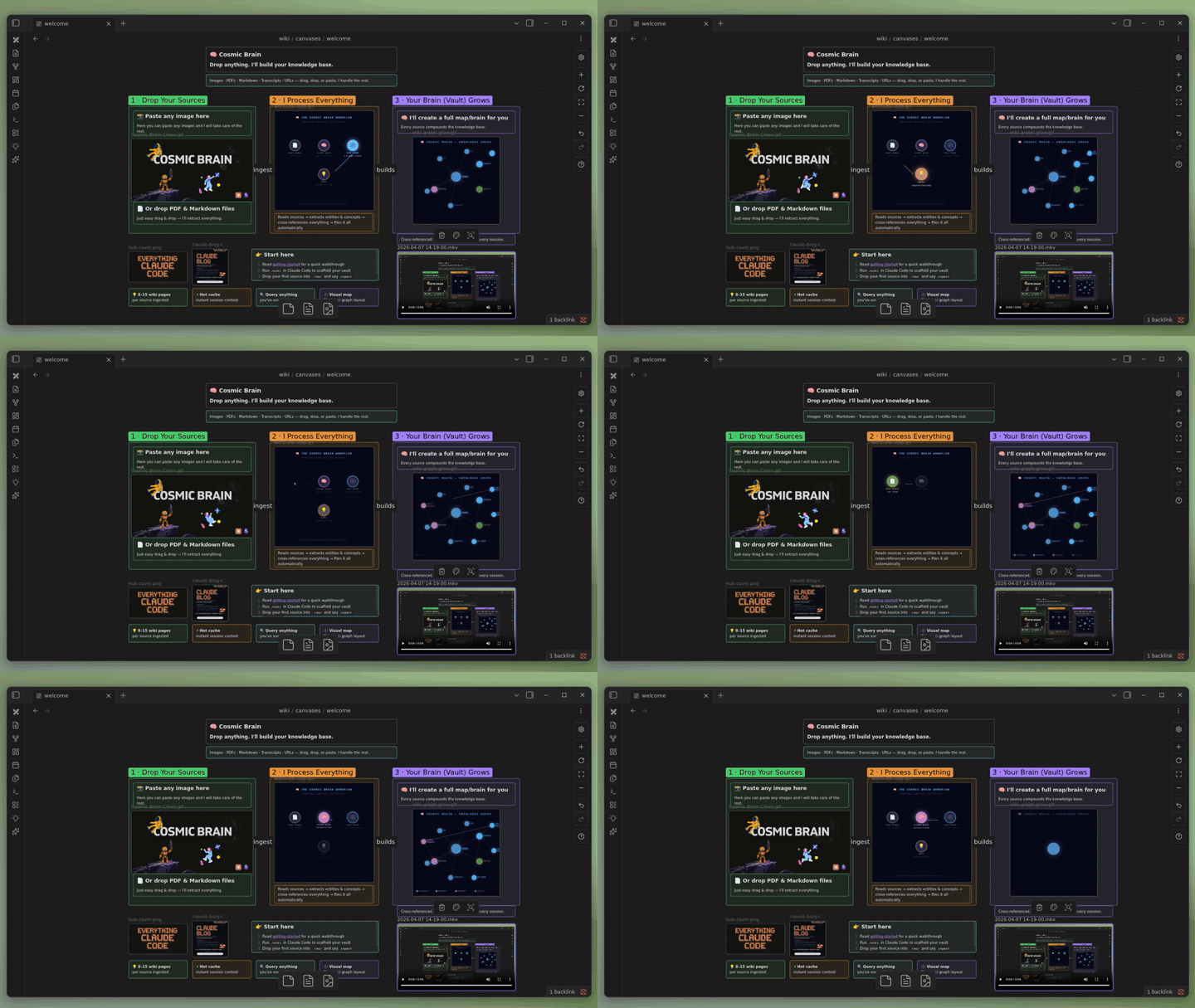
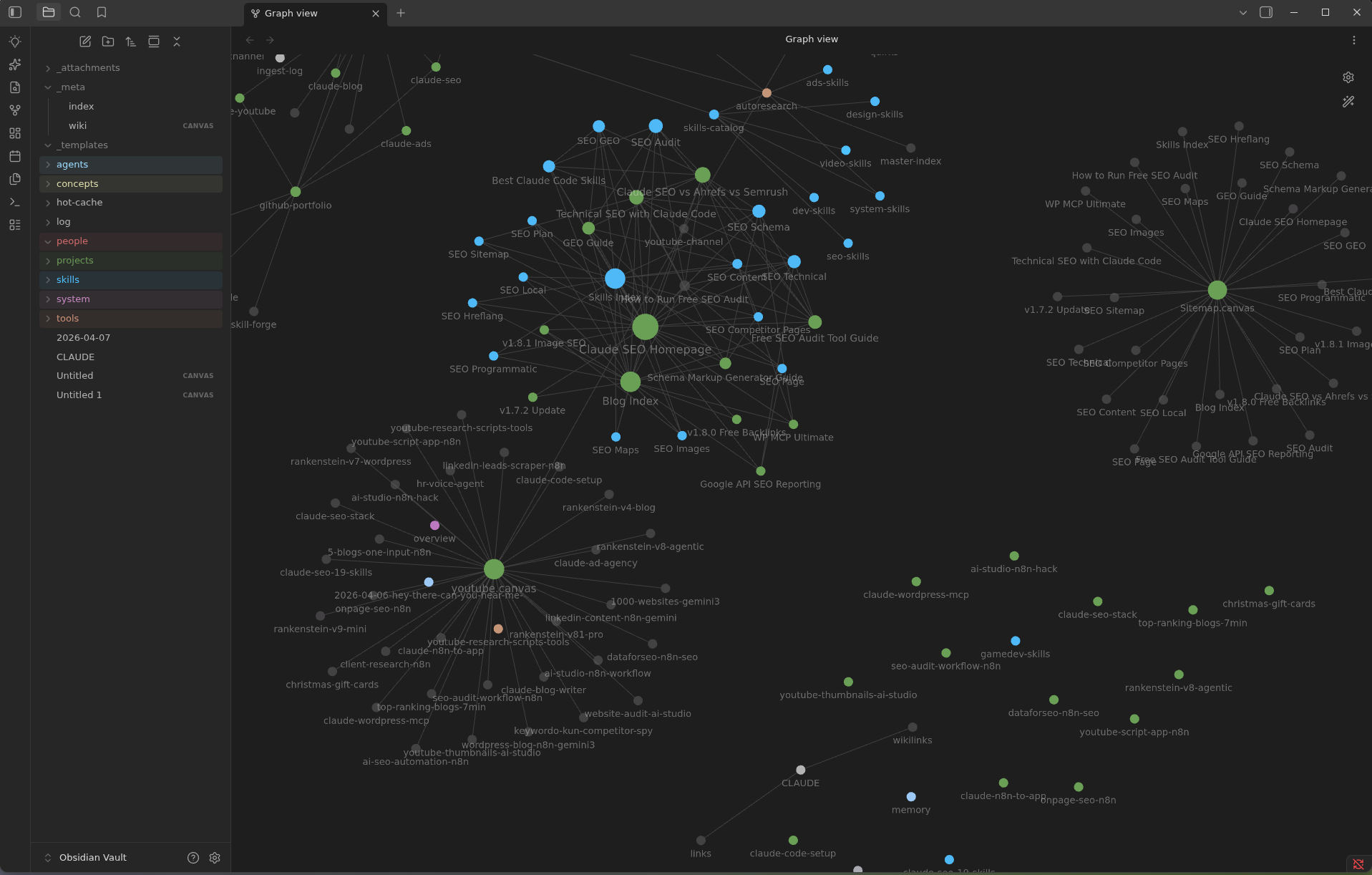
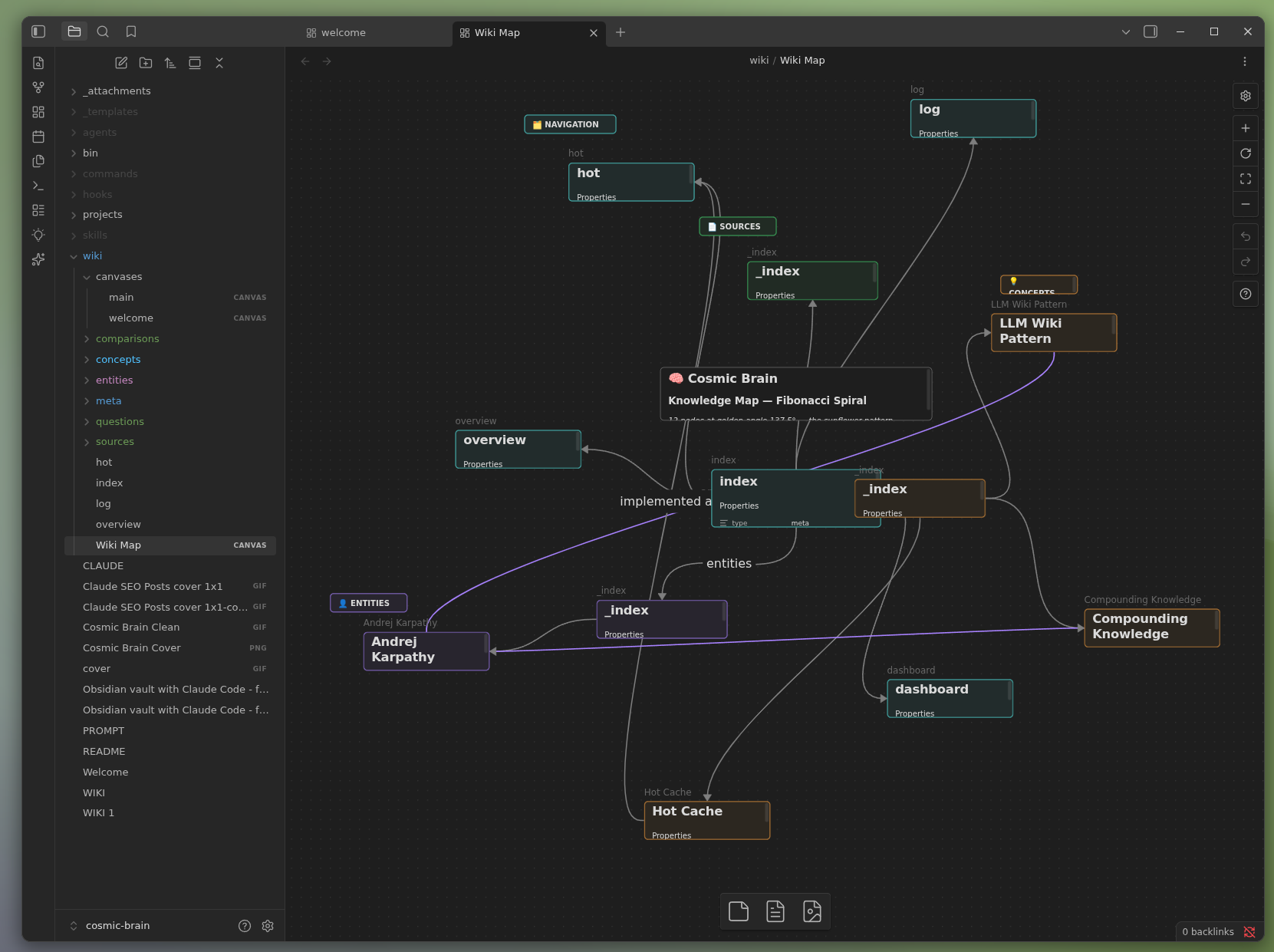
You drop sources. Claude reads them, extracts entities and concepts, updates cross-references, and files everything into a structured Obsidian vault. The wiki gets richer with every ingest.
You ask questions. Claude reads the hot cache (recent context), scans the index, drills into relevant pages, and synthesizes an answer. It cites specific wiki pages, not training data.
You lint. Claude finds orphans, dead links, stale claims, and missing cross-references. Your wiki stays healthy without manual cleanup.
At the end of every session, Claude updates a hot cache. The next session starts with full recent context, no recap needed.
Why claude-obsidian?
Most Obsidian AI plugins are chat interfaces. They answer questions about your existing notes. claude-obsidian is a knowledge engine. It creates, organizes, maintains, and evolves your notes autonomously.
| Capability | claude-obsidian | Smart Connections | Copilot | |---|---|---|---| | Auto-organize notes | ✅ Creates entities, concepts, cross-references | ❌ | ❌ | | Contradiction flagging | ✅ [!contradiction] callouts with sources | ❌ | ❌ | | Session memory | ✅ Hot cache persists between conversations | ❌ | ❌ | | Vault maintenance | ✅ 8-category lint (orphans, dead links, gaps) | ❌ | ❌ | | Autonomous research | ✅ 3-round web research with gap-filling | ❌ | ❌ | | Methodology modes | ✅ LYT / PARA / Zettelkasten / Generic (first-class) | ❌ | ❌ | | Thinking framework | ✅ 10-principle loop as invocable skill | ❌ | ❌ | | Multi-model support | ✅ Claude, Gemini, Codex, Cursor, Windsurf | ❌ Claude only | ✅ Multiple | | Visual canvas | ✅ Via claude-canvas | ❌ | ❌ | | Multi-writer safe | ✅ Per-file advisory locks (v1.7+) | ❌ | ❌ | | Query with citations | ✅ Cites specific wiki pages | ✅ Cites similar notes | ✅ Cites notes | | Batch ingestion | ✅ Parallel agents for multiple sources | ❌ | ❌ | | Open source | ✅ MIT | ✅ MIT | ⚠️ Freemium |
📖 Deep dive: I Turned Obsidian Into a Self-Organizing AI Brain. Full breakdown with data visualizations, market context, and workflow demos.
Quick Start
ℹ️ The commands below install the public open-source build fromAgriciDaniel/claude-obsidian(recommended, no membership needed). AI Marketing Hub Pro members who want early access to in-development features can swapAgriciDaniel/claude-obsidianforAI-Marketing-Hub/claude-obsidian(Option 2 also swaps the plugin slug; see the note under that option).
Option 1: Clone as vault (recommended, full setup in 2 minutes)
git clone https://github.com/AgriciDaniel/claude-obsidian
cd claude-obsidian
bash bin/setup-vault.sh
Open the folder in Obsidian: Manage Vaults → Open folder as vault → select claude-obsidian/.
Open Claude Code in the same folder. Type /wiki.
ℹ️setup-vault.shconfiguresgraph.json(filter + colors),app.json(excludes plugin dirs), andappearance.json(enables CSS). Run it once before the first Obsidian open. You get the fully pre-configured graph view, color scheme, and wiki structure out of the box.
Option 2: Install as Claude Code plugin
Plugin installation is a two-step process. First add the marketplace catalog, then install the plugin from it.
ℹ️ Which version are you installing?>
- Public (recommended, no membership): the commands below install the free, MIT-licensed release from AgriciDaniel/claude-obsidian. Nothing to sign up for.
- AI Marketing Hub Pro member? For early access to in-development features, swapAgriciDaniel/claude-obsidianforAI-Marketing-Hub/claude-obsidianand the plugin slugclaude-obsidian@agricidaniel-claude-obsidianforclaude-obsidian@ai-marketing-hub-claude-obsidian. The org mirror requires an authenticatedgh auth login(or GitHub PAT) with access to theAI-Marketing-Huborg. If/plugin marketplace addreturns a 404, your account is not in the org yet. DM in the Skool community to get added.
# Step 1: add the marketplace
claude plugin marketplace add AgriciDaniel/claude-obsidian
Step 2: install the plugin
claude plugin install claude-obsidian@agricidaniel-claude-obsidian
In any Claude Code session: /wiki. Claude walks you through vault setup.
To check it worked:
claude plugin listOption 3: Add to an existing vault
Copy WIKI.md into your vault root. Paste into Claude:
Read WIKI.md in this project. Then:
- Check if Obsidian is installed. If not, install it.
- Check if the Local REST API plugin is running on port 27124.
- Configure the MCP server.
- Ask me ONE question: "What is this vault for?"
Then scaffold the full wiki structure.Commands
| You say | Claude does | |---------|------------| | /wiki | Setup check, scaffold, or continue where you left off | | ingest [file] | Read source, create 8-15 wiki pages, update index and log | | ingest all of these | Batch process multiple sources, then cross-reference | | what do you know about X? | Read index, drill into relevant pages, synthesize answer | | /save | File the current conversation as a wiki note | | /save [name] | Save with a specific title (skips the naming question) | | /autoresearch [topic] | Run the autonomous research loop: search, fetch, synthesize, file | | /canvas | Open or create the visual canvas, list zones and nodes | | /canvas add image [path] | Add an image (URL or local path) to the canvas with auto-layout | | /canvas add text [content] | Add a markdown text card to the canvas | | /canvas add pdf [path] | Add a PDF document as a rendered preview node | | /canvas add note [page] | Pin a wiki page as a linked card on the canvas | | /canvas zone [name] | Add a new labeled zone to organize visual content | | /canvas from banana | Capture recently generated images onto the canvas | | /think [problem] | Apply the 10-principle thinking loop to a non-trivial problem | | lint the wiki | Health check: orphans, dead links, gaps, suggestions | | update hot cache | Refresh hot.md with latest context summary |
✨ Want more? claude-canvas adds 12 templates, 6 layout algorithms, AI image generation, presentations, and full canvas orchestration. Install both, they complement each other.
/wiki: setup, scaffold, continue
First-run setup walks through:
- Check Obsidian is installed
- Check Local REST API plugin (if MCP transport desired)
- Ask "What is this vault for?" (one question, drives the scaffold)
- Scaffold per chosen Methodology Mode and Vault Use Case
- Seed
hot.md,index.md,log.md,wiki/meta/dashboard.base - Suggest the first ingest
/wiki continues where you left off. It checks vault health, surfaces stale claims, and shows recent activity from hot.md.
/autoresearch: autonomous research loop
Configurable program at skills/autoresearch/references/program.md:
- Max rounds (default 3)
- Max pages per session (default 15)
- Source preference rules (academic, official docs, news)
- Confidence scoring + domain constraints
- Round 1, broad search: decompose into 3-5 angles, run 2-3 queries per angle, fetch top 2-3 results per angle
- Round 2, gap fill: targeted searches for contradictions and missing pieces
- Round 3, synthesis check (optional): one more pass if major gaps remain
- Filing: synthesis page + source pages + entity pages + concept pages, all cross-referenced
## Web egress hygiene (v1.8.2+) policy in skills/autoresearch/SKILL.md: rejects file:// / ` / RFC1918 hosts, strips