
The Self-Evolving Agent Ecosystem — Trading agents that evolve through Darwinian selection and adversarial self-play
🧬 Darwinia
Give your AI agent the power to evolve its own trading strategies.
Trading agents that discover strategies through Darwinian selection and adversarial self-play — not human-written rules.







For OpenClaw / Claude Code agents
Tell your agent:
"Install Darwinia and evolve a BTC trading strategy."
Darwinia ships as an OpenClaw skill and Claude Code skill. Your agent can install it, run evolution, and report results — all through natural language.
Manual skill installation
OpenClaw:
mkdir -p ~/.openclaw/skills/darwinia cp .openclaw/SKILL.md ~/.openclaw/skills/darwinia/SKILL.mdClaude Code: Auto-detected from .claude/SKILL.md in project root.
The problem
You hand-code RSI > 70 = sell. Market regime changes. Strategy dies. You tweak parameters manually. Repeat forever.
The Darwinia approach
50 agents with random DNA compete on real BTC data. The weak die. The strong breed. After 50 generations, survivors handle rug pulls, fake breakouts, and whipsaws — not because you told them to, but because agents that couldn't handle these attacks didn't survive to reproduce.
Before:  Human writes rules → Agent executes → Market changes → Strategy dies
After:   Human sets environment → Agents evolve → Survivors adapt → Patterns emerge
Quick Start
git clone https://github.com/0xSanei/darwinia.git
cd darwinia
pip install -e ".[dev]"
Evolve trading strategies (30 seconds)
python -m darwinia evolve -g 10
Test champion against adversarial attacks
python -m darwinia arena
Launch interactive dashboard
python -m darwinia dashboard
No API keys. No cloud. Just Python + numpy. BTC data included.
Demo Output (click to expand)
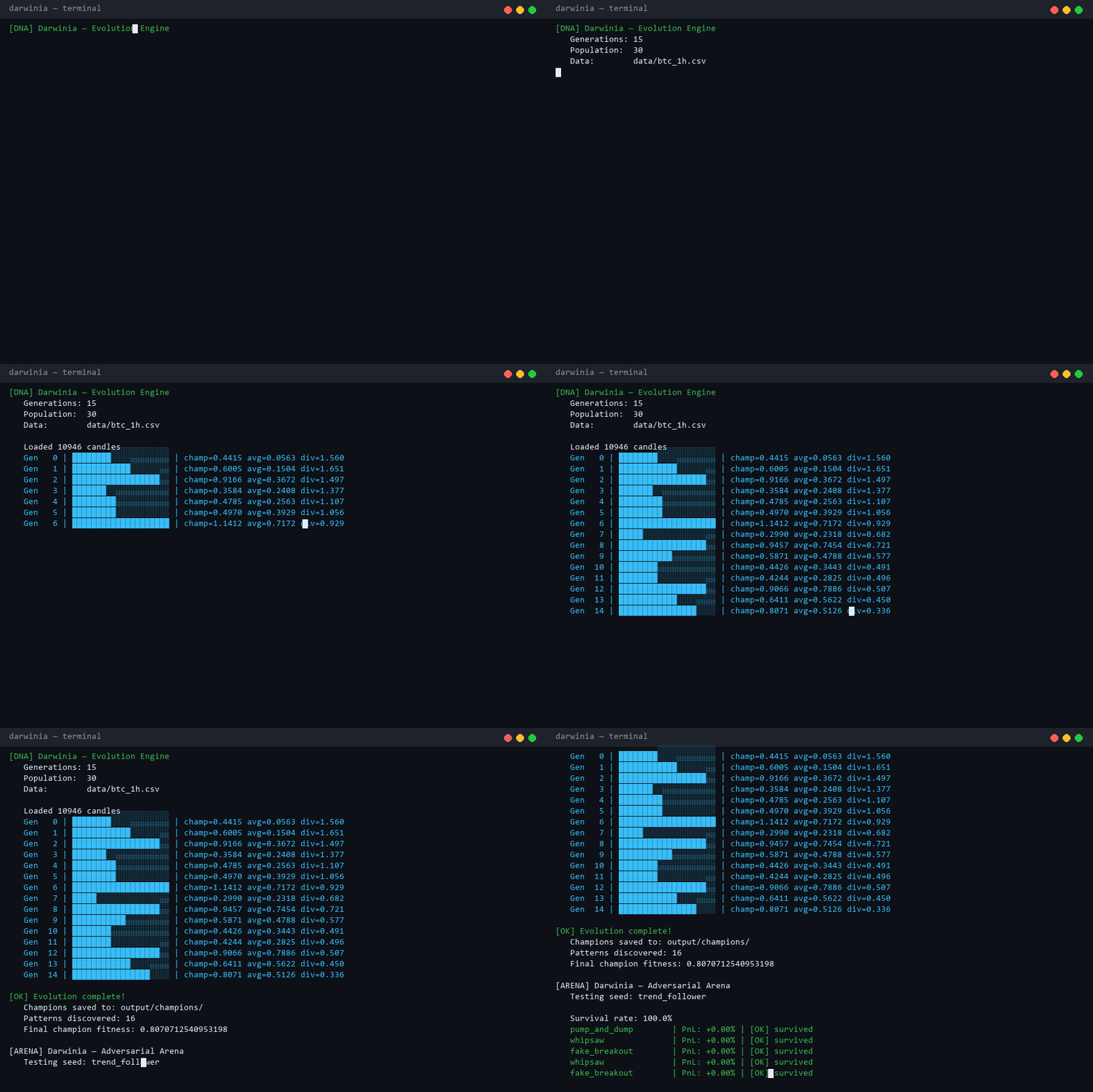
Evolution run:
🧬 Darwinia — Evolution Engine    Generations: 20 | Population: 30 | Data: BTC/USDT 1h (10,946 candles)
Gen   0 | ██████░░░░░░░░░░░░░░ | champ=0.32 avg=0.04 div=1.56    Gen   1 | █████████████░░░░░░░ | champ=0.69 avg=0.24 div=1.60    Gen   2 | ███████████████████████████ | champ=1.35 avg=0.64 div=1.32    Gen   5 | █████████████████████████████ | champ=1.46 avg=0.43 div=0.81    Gen  12 | █████████████████████ | champ=1.09 avg=0.82 div=0.72    Gen  13 | ████████████████████████ | champ=1.24 avg=0.64 div=0.57    Gen  19 | ████████░░░░░░░░░░░░ | champ=0.42 avg=0.12 div=0.44
✅ Evolution complete! 16 patterns discovered.
Adversarial arena test:
⚔️ Darwinia — Adversarial Arena    Testing evolved champion against targeted attacks...
whipsaw              | PnL: +0.00% | ✅ survived    fake_breakout        | PnL: +0.00% | ✅ survived    pumpanddump        | PnL: +0.00% | ✅ survived    rug_pull             | PnL: -3.21% | ✅ survived    slow_bleed           | PnL: -1.05% | ✅ survived
Survival rate: 100.0%
How It Works
Genesis Pool          Adversarial Arena         Pattern Discovery
   ┌──────────┐         ┌───────────────┐         ┌────────────────┐
   │ 50 agents │───────▶│ Alpha agent   │───────▶│ Analyze WHY     │
   │ with random│        │    vs         │        │ survivors won   │
   │ DNA + seeds│        │ Adversary     │        │                 │
   └──────────┘         │ (6 attacks)   │        │ → Discover new  │
                        └───────┬───────┘        │   market patterns│
                                │                └────────┬────────┘
                    ┌───────────▼───────────┐             │
                    │   NATURAL SELECTION    │◀────────────┘
                    │                       │
                    │ Top 20% survive       │
                    │ Crossover + Mutation   │
                    │ → Next Generation     │
                    └───────────────────────┘
Each generation: Compete → Survive attacks → Select → Breed → Mutate → Discover
17-Gene DNA
Every trading decision lives in a genome:
| Category | Genes | Controls | |----------|-------|----------| | Signal | 5 | What matters — momentum, volume, volatility, mean reversion, trend | | Threshold | 4 | When to act — entry/exit triggers, stop loss, take profit | | Personality | 5 | How to behave — risk appetite, time horizon, contrarian bias, patience, sizing | | Adaptation | 3 | How to learn — regime sensitivity, memory length, noise filtering |
Adversarial Arena
Most bots are tested against history. Darwinia agents are tested against an adversary trying to destroy them.
| Attack | What It Does | Who It Traps | |--------|-------------|-------------| | Rug Pull | Steady rise → sudden 90% crash | Trend followers without stops | | Fake Breakout | Breaks resistance → immediate reversal | Breakout traders | | Slow Bleed | Gradual decline + misleading bounces | Patient agents with loose stops | | Whipsaw | Rapid alternating moves | Tight-stop agents | | Volume Mirage | Volume spike, no follow-through | Volume-dependent strategies | | Pump & Dump | Rapid pump → rapid dump | Momentum chasers |
The adversary reads the agent's DNA and picks attacks targeting its weaknesses. Over generations, this creates an arms race.
Pattern Discovery
After each generation, Darwinia finds what survivors agree on:
- Gene convergence: All survivors evolved high noise filtering? That's a pattern.
- Linked genes: High risk appetite always paired with short time horizon? That's a combo.
- Human mapping: Evolved "high contrarian_bias" = mean reversion strategy.
- Novel patterns: Gene combos with no known human equivalent = new discovery.
Results
50-generation evolution on 10,946 BTC/USDT 1h candles:
| Metric | Gen 0 | Gen 50 | |--------|-------|--------| | Champion Fitness | ~0.15 | ~0.75+ | | Attack Survival | ~30% | 98-100% | | Strategy Species | 1 (random) | 3-4 distinct | | Patterns Found | 0 | 10-20 |
Agent Integration
All commands support --json for machine-readable output:
python -m darwinia evolve -g 50 --json{
"champion": {
"id": "a3f2c1d8",
"fitness": 1.35,
"genes": {"weighttrend": 0.87, "stoplosspct": 0.04, "riskappetite": 0.35}
},
"evolution_summary": {
"generations_run": 50,
"patterns_discovered": 16
}
}| Platform | Integration | |----------|-------------| | OpenClaw | .openclaw/SKILL.md — integration guide | | Claude Code | .claude/SKILL.md — auto-detected in project | | Any CLI agent | python -m darwinia evolve --json |
CLI Reference
python -m darwinia evolve -g 100 -p 80        # 100 gens, 80 agents
python -m darwinia evolve -d my_data.csv       # Custom data
python -m darwinia evolve --json               # JSON output for agents
python -m darwinia arena -c output/champions/championgen0049.json
python -m darwinia arena -r 10 --json          # 10 rounds, JSON output
python -m darwinia validate -w 3 -g 20         # Walk-forward overfitting check
python -m darwinia explain -c champion.json    # Gene ablation analysis
python -m darwinia evolve --multi               # Multi-asset evolution (BTC+ETH+SOL)
python -m darwinia evolve --macro              # Macro-aware evolution (regime overlay)
python -m darwinia fetch ETHUSDT -i 4h -d 90   # Fetch live data from Binance
python -m darwinia fetch BTCUSD --source coingecko  # Fetch from CoinGecko
python -m darwinia scan                        # Discover trending crypto assets
python -m darwinia scan --volatile             # Most volatile assets
python -m darwinia scan --recommend            # Recommended pairs for evolution
python -m darwinia analytics -g 20 -p 50       # Population convergence & clustering
python -m darwinia tournament -n 8 -g 30       # Champion round-robin leaderboard
python -m darwinia repair -c champion.json     # Auto-detect and fix strategy degradation
python -m darwinia dashboard                   # Web UI
python -m darwinia info --json                 # System info as JSON
Dashboard
Four interactive views built with Streamlit:
| Evolution | Family Tree | |:---------:|:-----------:| | 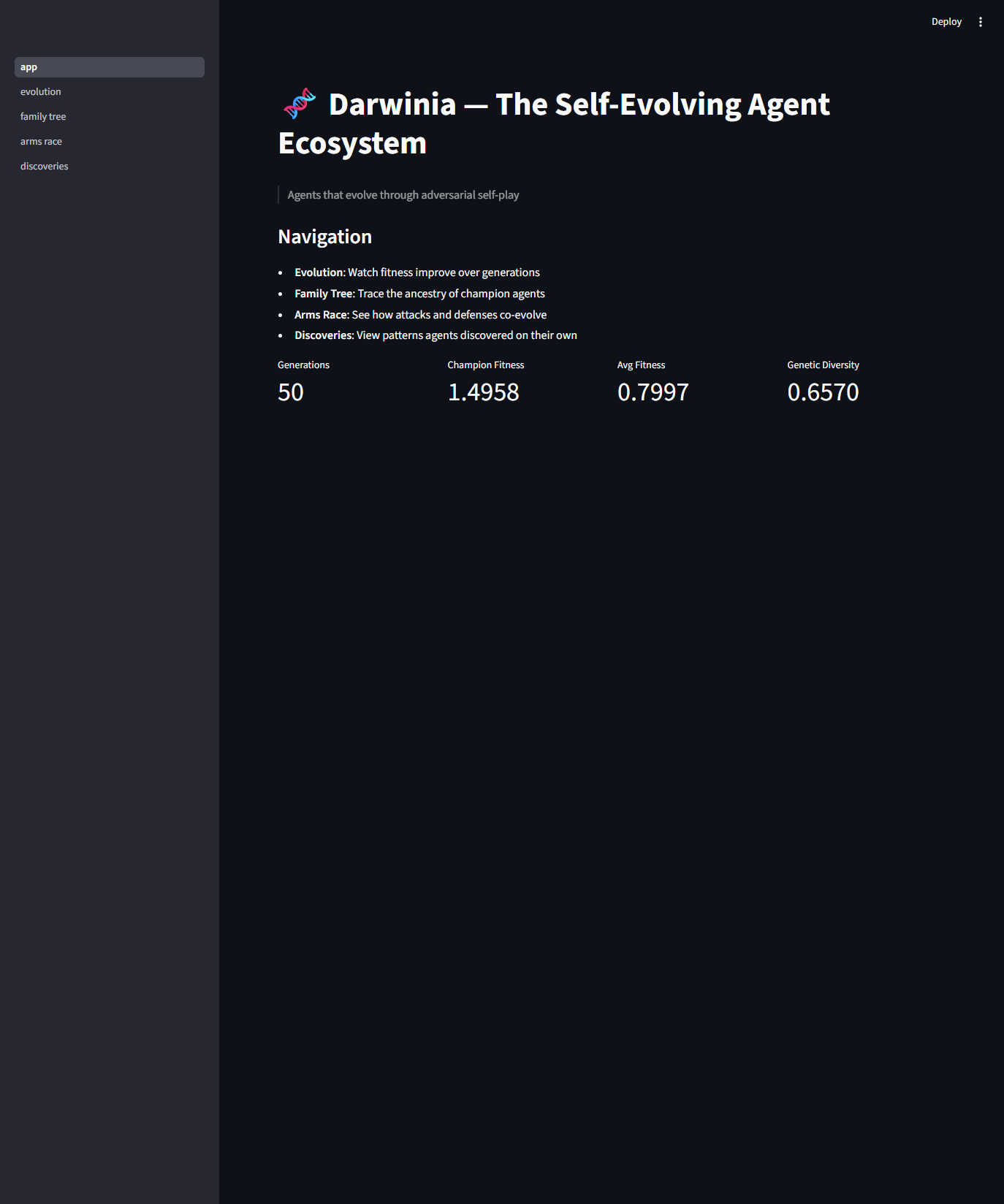 |
| 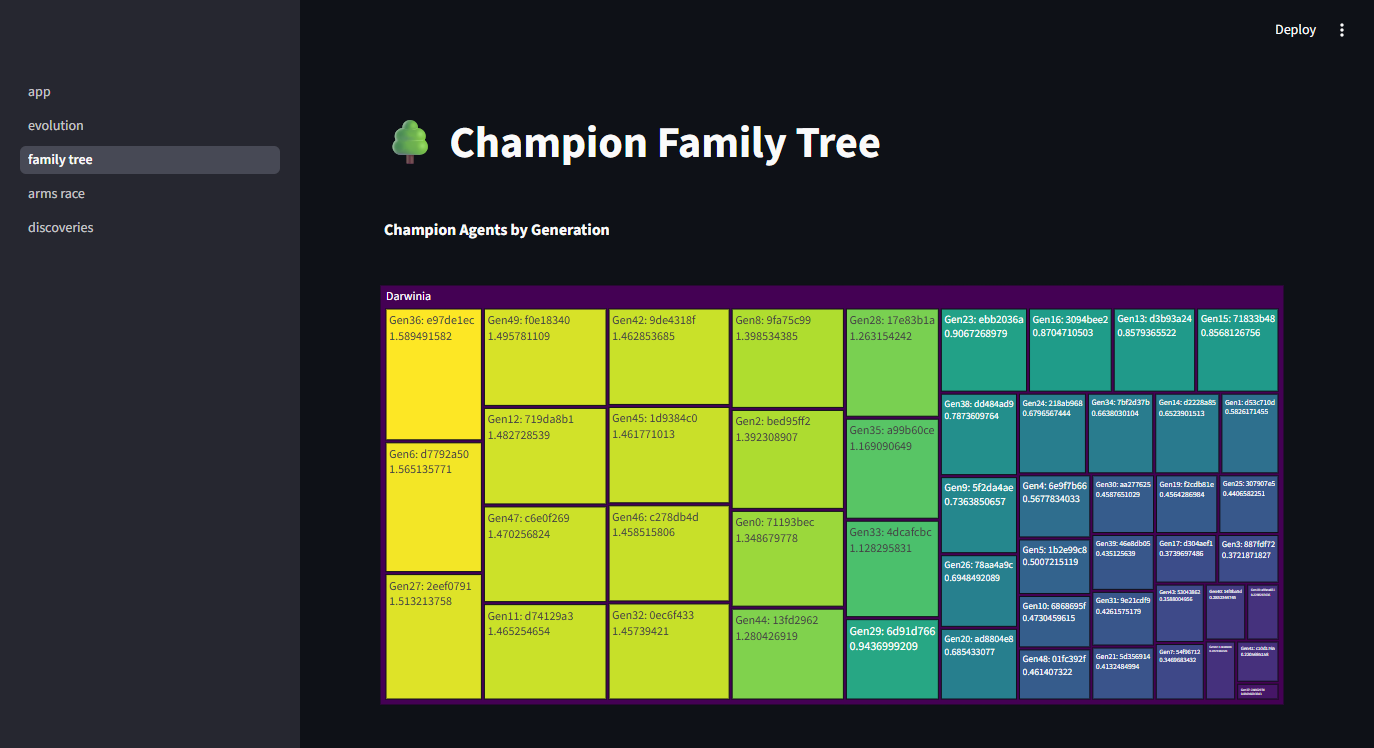 | | Fitness metrics + population stats | Champion ancestry treemap |
| Arms Race | Discoveries | |:---------:|:-----------:| | 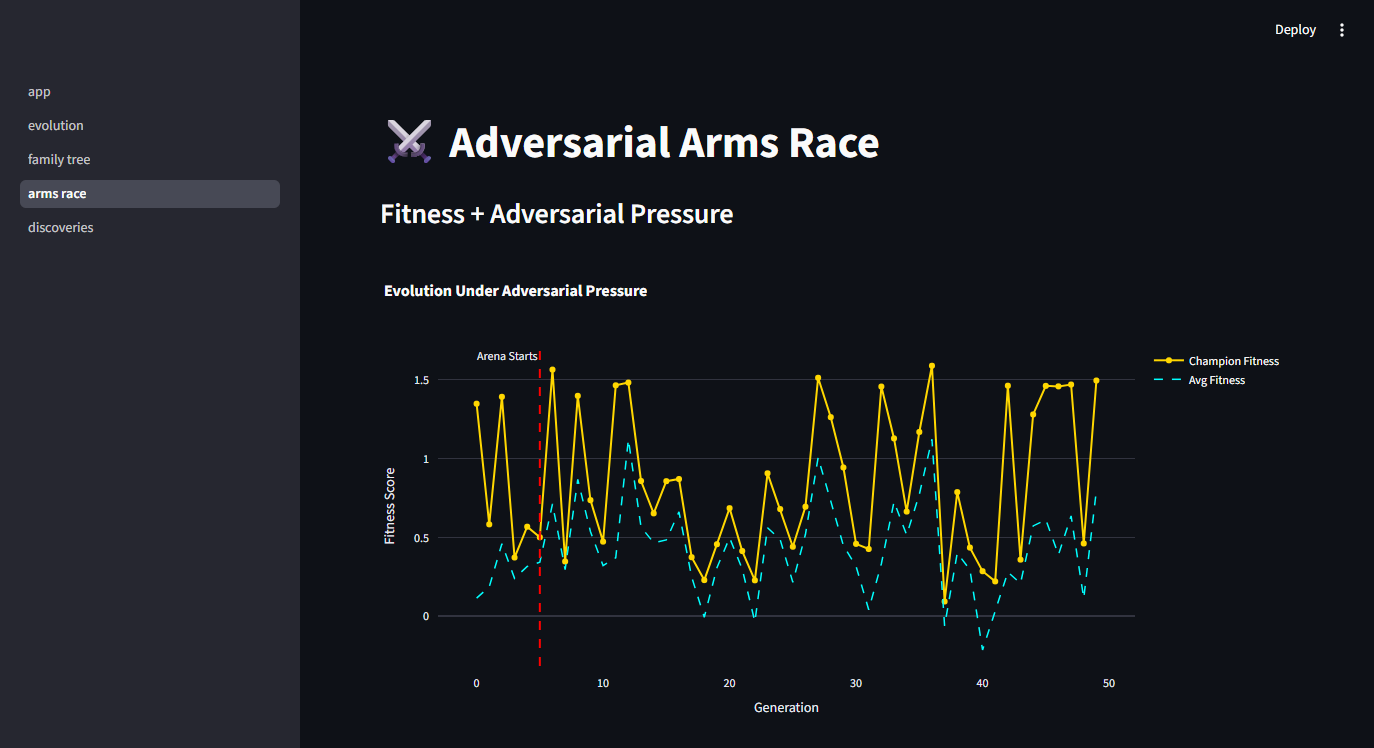 |
| 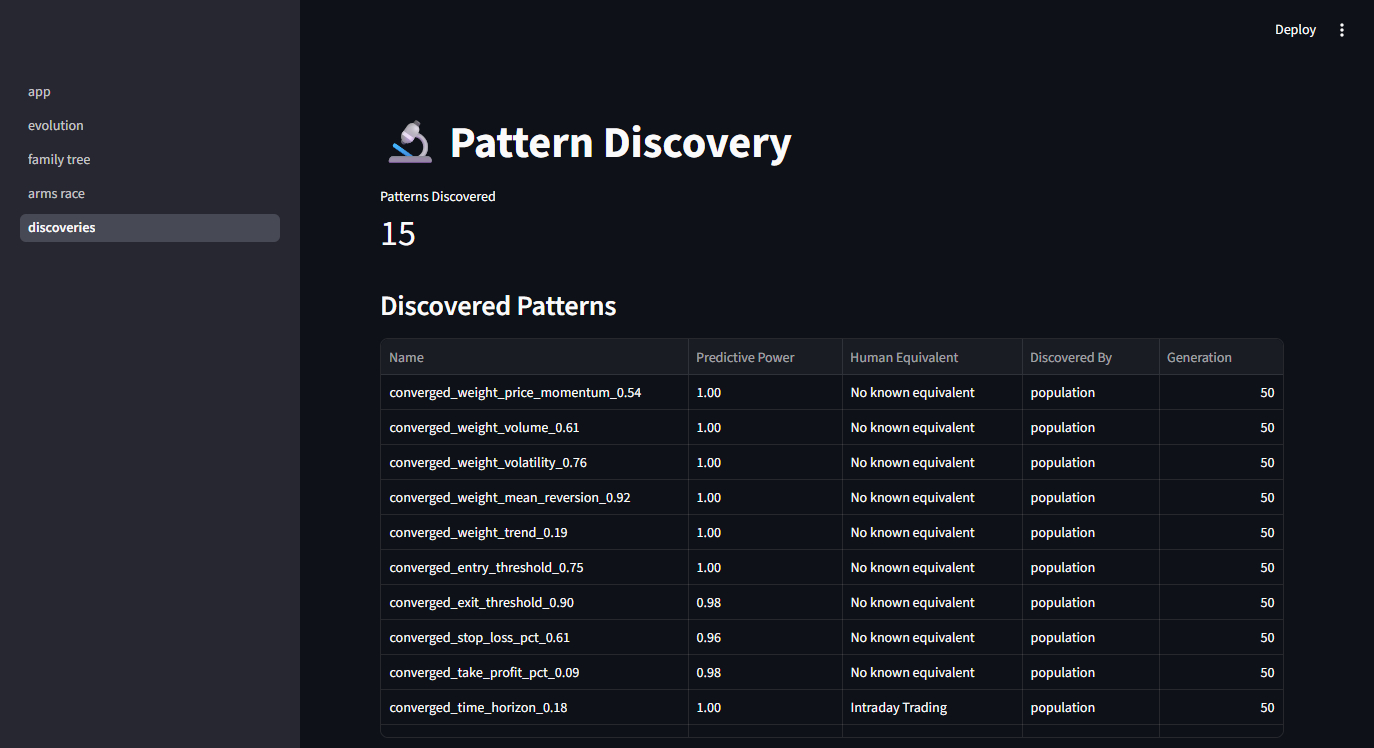 | | Fitness under adversarial pressure | Emergent patterns table |
Architecture
darwinia/
├── core/          # DNA, agent, market environment
├── evolution/     # Population, fitness, selection, breeding
├── arena/         # Adversarial attacks and combat
├── discovery/     # Pattern analysis and naming
├── chronicle/     # History recording and species tracking
├── personality/   # Personality profiling + market regime detection
├── knowledge/     # Layer 3: Pattern marketplace and knowledge exchange
├── data/          # Live data fetching (Binance, CoinGecko)
├── macro/         # Macro regime simulation and regime-aware fitness
├── integrations/  # Skill composability layer (SkillBridge, SkillRegistry)
├── analytics/     # Population statistics, clustering, diversity metrics
├── repair/        # Self-repair: health monitoring + auto-fix degraded strategies
└── main.py    # CLI entry point (22 commands)
dashboard/         # Streamlit visualization (4 pages) scripts/           # Competitor monitoring, utilities
Validation & Explainability
Walk-Forward Validation splits data chronologically (train on past, test on future). If fitness degrades out-of-sample, the strategy is overfitting.
python -m darwinia validate -w 3 --jsonGene Ablation zeroes each gene one at a time and measures fitness drop. Genes that cause the biggest drop are the most important — proving the agent found real signal, not noise.
python -m darwinia explain -c champion.json --jsonMacro-Aware Evolution
Standard backtests ignore macro conditions. With --macro, Darwinia generates a regime overlay (risk-on, risk-off, transition) and rewards agents that adapt position sizing to macro state. Agents that go full-size during risk-off get penalized. Agents that scale down survive.
python -m darwinia evolve --macro --jsonAsset Auto-Discovery
Instead of hardcoding which asset to train on, scan finds high-volume volatile assets — the best training data for genetic evolution.
python -m darwinia scan --recommend --jsonSelf-Repair
Strategies degrade as markets shift. repair monitors fitness drift and applies targeted fixes — re-randomizing only the weakest genes instead of re-evolving from scratch.
python -m darwinia repair -c champion.json --method targeted --jsonThree repair modes: targeted (fix weak genes via ablation), full (re-evolve from seed), ensemble (mutate 3 variants, pick best).
Backtesting & Strategy Export
Full performance analysis with quantitative finance metrics:
# Single-pass backtest with Sharpe, Sortino, Calmar, max drawdown
python -m darwinia backtest -c champion.json -d data/btc_1h.csv
Walk-forward backtest (5 rolling windows)
python -m darwinia backtest -c champion.json --walk-forward -w 5
Multi-asset generalization test
python -m darwinia backtest -c champion.json --multi
Export strategy as portable JSON
python -m darwinia export -c champion.json
Metrics: Sharpe ratio, Sortino ratio, Calmar ratio, max drawdown ($ and %), drawdown duration, win rate, profit factor, average win/loss, annualized return. Walk-forward mode tests stability across rolling windows. Multi-asset mode tests whether a strategy generalizes beyond its training data.
Ensemble Committee
Combine multiple evolved strategies into a committee that votes on each trade decision:
# 5-member committee with majority voting
python -m darwinia ensemble -d data/btc_1h.csv -s 5 --mode majority
Fitness-weighted voting (better strategies count more)
python -m darwinia ensemble --mode weighted
Unanimous mode (all must agree, else hold)
python -m darwinia ensemble --mode unanimous
Monte Carlo Stress Testing
Run hundreds of randomized market simulations to test strategy robustness:
# 500 bootstrap simulations
python -m darwinia montecarlo -c champion.json -n 500
Add noise to prices
python -m darwinia montecarlo -c champion.json --method noise
Shuffle returns to destroy structure
python -m darwinia montecarlo -c champion.json --method shuffle
Reports 95%/99% confidence intervals, probability of profit, and return distribution.
Benchmark Baselines
Compare your evolved strategy against 5 standard baselines:
python -m darwinia benchmark -c champion.json -d data/btc_1h.csvBaselines: Buy-and-Hold, Random Trader, Mean Reversion, Momentum, DCA. Ranked by Sharpe ratio so you can see exactly where evolution adds value.
Strategy Fingerprint
Visualize a strategy's genetic identity:
python -m darwinia fingerprint -c champion.json
python -m darwinia fingerprint -c champion.json --json
Shows DNA as an ASCII radar chart, classifies into archetypes (Aggressive Momentum, Conservative Mean-Reversion, Scalper, Trend Follower, Contrarian, Balanced Adaptive), and highlights dominant traits.
Portfolio Allocator
Distribute capital across a basket of evolved strategies:
python -m darwinia portfolio --champions out/a.json out/b.json out/c.json --method risk_parity
python -m darwinia portfolio -s 5 --method kelly --json
Five allocation methods: equalweight, sharpeweighted, riskparity, inversevariance, and fractional kelly. Reports portfolio Sharpe, volatility, and the diversification ratio so you can see when stacking strategies actually adds value vs. concentrating capital in the best one.
Market Regime Detection
Classify market data into regimes for adaptive strategy behavior:
python -m darwinia regime -d data/btc_1h.csv -w 20
python -m darwinia regime -d data/btc_1h.csv --json
Five regimes: trendingup, trendingdown, meanreverting, highvolatility, low_volatility. Uses rolling z-scored trend strength, volatility, and autocorrelation. Reports regime distribution, segment analysis, transition matrix, and stability score.
Cross-Strategy Correlation
Identify redundant vs diversified strategies:
python -m darwinia correlation --champions a.json b.json c.json
python -m darwinia correlation -s 6 --json
Runs multiple strategies on the same data, bins trade returns into time buckets, and computes pairwise Pearson correlation. ASCII heatmap, auto-clustering, and pair extremes (most/least correlated). Critical input for portfolio construction — high correlation means you're doubling down, not diversifying.
Skill Composability
Darwinia exposes a SkillBridge API for other ClawHub skills to call it programmatically, and a SkillRegistry for Darwinia to call external skills (macro-liquidity, crypto-market-rank, okx-dex-market). This makes Darwinia a composable building block in multi-skill agent workflows.
Three Layers
| Layer | Status | What It Does | |-------|--------|-------------| | Evolution Engine | ✅ Implemented | Genetic algorithm + adversarial arena + pattern discovery | | Personality Engine | ✅ Implemented | Quantified trading personalities + market regime detection | | Knowledge Protocol | ✅ Implemented | Agents trade discovered patterns through a marketplace |
Beyond Trading
The evolution engine is domain-agnostic. The DNA → Fitness → Selection → Breed cycle works for any agent behavior that can be scored. This release targets crypto trading, but the framework applies to portfolio optimization, risk tuning, resource allocation, game strategy — any domain where you can define a fitness function.
Development
make setup       # Install dependencies
make test        # Run 176 tests
make evolve      # Run 50 generations
make arena       # Adversarial arena
make dashboard   # Streamlit dashboard
Design Philosophy
Traditional quant: human designs strategy from theory. Darwinia: human designs the environment. Agents discover the strategy.
Your role shifts from strategy author to environment designer — define the data, the fitness function, the attacks. Let evolution find the rest.
License
MIT


